Operations
The railroad operates under Timetable and Train Order (T&TO) rules following 1905 railroad practice. Movements on the main line are governed by the published timetable; trains not provided for in the timetable require written authorization from the Dispatcher before they may proceed.
Northern Lights Subdivision
The layout models two railroads on two levels:
- Upper level — a section of the Chesapeake & Ohio mainline between East staging (Cumberland, MD) and West staging (Covington, WV), passing through Williamsport.
- Lower level — the New York and Eastern Railroad, Northern Lights Subdivision. A freelanced branch on a C&O prototype basis, running point-to-point from Williamsport (WP) at the south terminus to Hemlock Crest (HC) at the north terminus, 135 modeled miles.
The line is single-track throughout, with passing sidings at all seven staffed stations. Southward trains are superior by direction.
| Station | Code | MP | Type |
|---|---|---|---|
| Williamsport | WP | 0 | South terminus — Junction — Yard |
| Xina Pass | XP | 37 / 43.5 | Register station — Train Order — Switchback |
| Becs Bend | BB | 58.4 | Train Order station |
| Jacks Creek | JC | 76.4 | Train Order station |
| Michelles Cove | MC | 78.2 | Train Order station — Switchback |
| Stans Knob | SK | 103.2 | Train Order station |
| Hemlock Crest | HC | 135 | North terminus — Register station |
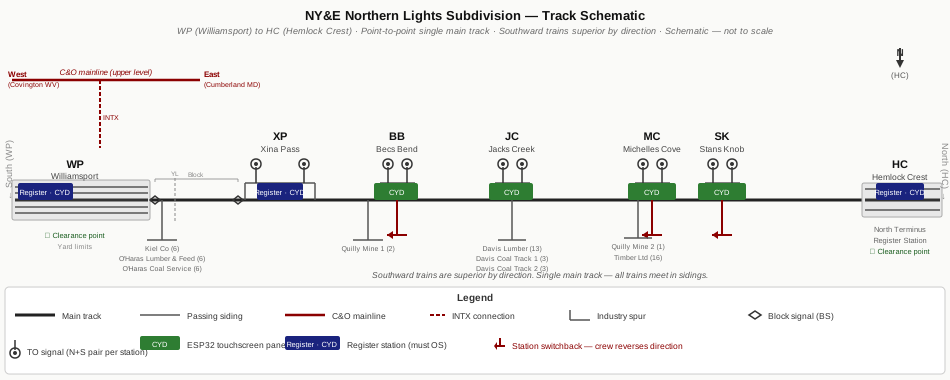
Track schematic — Northern Lights Subdivision
Timetable
The current working timetable is No. 4, effective December 31, 1904. It contains 22 scheduled trains on the Northern Lights Subdivision serving passenger, freight, coal, and coke traffic. A string table shows the scheduling diagram for all trains and their meeting points.
- NY&E Northern Lights Subdivision — Employee Timetable No. 4
- C&O East Central Subdivision — Williamsport Passing Times
- String Table No. 4
Operating Rules
Rules are based on the Standard Code of the American Railway Association (1906 edition). Train order form numbers follow the Standard Code. The following forms are active on the NY&E:
| Form | Purpose |
|---|---|
| A | Fixing Meeting Points for Opposing Trains |
| B | Authorizing a Train to Pass or Run Ahead |
| C | Giving Right Over Another Train |
| E | Time Orders (run late / wait until) |
| F | Creating Sections |
| G | Authorizing Extra Trains |
| H | Work Extras |
| J | Holding Order |
| K | Annulling a Schedule or a Section |
| L | Annulling an Order |
Train Superiority
A train is superior to another by right (conferred by train order), class (first class > second > third), or direction (southward trains are superior on this subdivision). Right is superior to class or direction; class is superior to direction. Extra trains are inferior to all scheduled trains regardless of direction.
A scheduled train that is 12 or more railroad hours behind its schedule loses both right and class and must thereafter operate as an extra by train order.
Register Stations
All trains must register at Xina Pass (XP) and at Hemlock Crest (HC). A clearance from the Dispatcher is required before a train may proceed beyond a register point or depart either terminus.
Operating Roles
Four roles interact with the layout during an operating session. One person may fill more than one role in a small session.
| Role | When | Responsibilities |
|---|---|---|
| Dispatcher | Live ops | Controls main-line movements. Issues train orders and clearance forms. Manages meets and authorizes extra trains. Operates from the Dispatcher web app on the layout server. |
| Yardmaster | Live ops | Controls Williamsport Yard exclusively. Assembles and deconstructs train consists, manages C&O interchange at Williamsport, and requests extra trains from the Dispatcher when needed. Operates from a dedicated touchscreen terminal at the yard. |
| Trainmaster | Pre-session | Reviews active car card and waybill assignments, builds train manifests, identifies extra trains required for the session, and produces the session plan file loaded onto the server before operations begin. |
| Owner | Pre-session + monitoring | Loads the session plan, verifies all systems are online, then monitors session status (read-only) while the Dispatcher controls live operations. |
Layout Control System
The IOTtrains project implements a WiFi-based layout control system for the Northern Lights Subdivision. A Raspberry Pi 5 serves as the layout WiFi access point and central server, hosting a fast railroad clock, an MQTT message broker, and the Dispatcher web app. Each of the seven stations has a fascia-mounted ESP32 colour touchscreen (CYD) for OS reporting, train order display, and TO signal arm control. Locomotive engineers connect phone throttles via WiThrottle through JMRI. The system is designed around 1905-era operating practice: train orders are formatted per ARA Standard Code forms, clearance forms are issued digitally to station agents, and the fast clock runs at a 3:1 ratio.